
Now that the Bundesrat, Germany’s upper house of parliament, is backing a bill proposed by the state of Hessen to criminalize the denial of the state of Israel’s right to exist, an opportunity falls into our hands - to quickly actually talk about Israel’s right to exist, before it is illegal for me to type these words from my apartment in the German capital.
I’ll start by saying that Israel’s right to exist doesn’t exist legally, but it exists discoursively. It is being a topic of conversation and is not disappearing just because such a right isn’t in the law books. One might talk about how states don’t legally have the right to exist, only people do - and I understand the sentiment of it, when the jurist Francesca Albanese uses this line of argument. She is a lawyer, after all. But I don’t think the legal argument is enough to cut it, for two main reasons: first, laws are man-made. Especially in Germany in general and particularly after the last few years, where we have seen criminalization of organizations, of people who were denied entry, of certain quotes repeated, of sentences and of languages in demonstrations, one should know that what isn’t a legal category today - like states’ right to exist - might become a legal category tomorrow. In fact, it would be taking lawmakers’ and lobbyists’ work lightly to assume they don’t know that and aren’t working on changing the law as we speak.
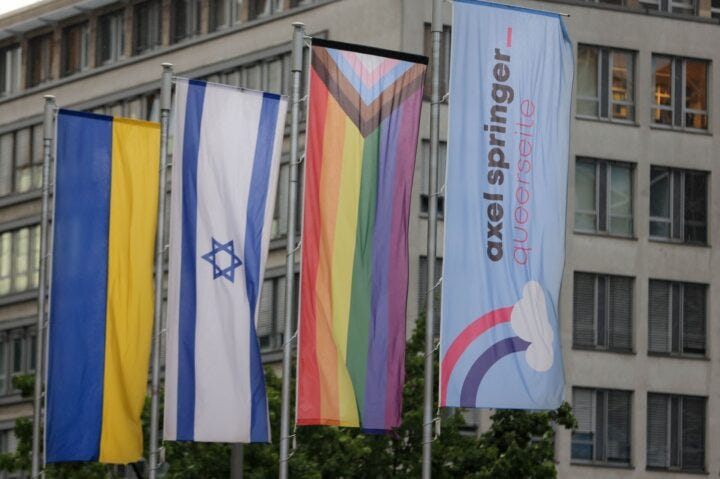
The second reason this argument isn’t sufficient is that we live in a time in which the assumed universalism of the law has been exposed as a fraud and the fraudsters aren’t even apologizing anymore. “From the river to the sea” is a sentence that is criminalized in demonstrations in Germany - if the intention behind it is “Palestine” or even “Equality” from the Jordan River to the Mediterranean Sea. But if Israel is meant by that phrase, it is absolutely allowed. But this is just one example; the list of examples is truly something for history books to collect. Ukraine not only has a right to use armed resistance against an occupier — Germany will even provide them with the weapons to do so — the Palestinians, on the other hand, don’t possess this right, because Israel is an ally. Rape as a means of war is horrific and absolutely illegal - when Hamas are using it, but when Palestinian detainees are systematically raped in Israeli prisons, it barely gets any coverage, not to mention condemnation from the political class. The subjective application of the law lies bare for all to see.
Instead of using the legal argument, I suggest looking into the essence of so-called “Israel’s right to exist” and what it serves for Germany and Germans, what problem it is supposed to solve (hint: not any kind of an antisemitism problem), and seeing if there is a way around the solution of legally cementing a debate that is valid and should stay alive.
It’s about a few things. As already hinted at, Israel’s right to exist is an interpretable concept that allows the state to persecute unfavorable political voices. The grey zone is large enough for this to become an actual tool of political suppression. Take the recent comment by Israeli genocide scholar Omer Bartov in an interview with ZEIT: “I am for a Jewish state, only not this one”. Is that questioning Israel’s right to exist? Or the Israeli philosopher Omri Boehm’s binationalism? The federation suggested by Yonatan Zeigen, son of peace activist Vivian Silver who was murdered on October 7th? Are they all soon criminals expressing these ideas on German soil? These discussions would have to be held. But instead of holding them at academic conferences, book fairs or talk shows, they will be held in courtrooms. The difference being, of course, what is at stake for those who have expressed what the court might see as an illegitimate question into Israel’s alleged right to exist. Law enforcement and courtrooms already treat minorities and non-white Germans in a discriminatory way; there is no reason to think that new law won’t be a similar machine to divide a virtual “us” from a virtual “them”.
A second reason is Germany’s transition to a war economy. While car factories are being turned into weapon factories and new munition factories open, the German government is madly increasing its defence spending to be, as a percentage of the general annual budget, even higher than that of Israel, at the cost of health and education, of course, and arms deals with Israel are being sealed reportedly in billions of taxpayers’ euros. More and more of the German economy is relying on the production of arms, and it is making us all hostages to the whims of advocacy groups who always push for more restrictions on freedom of speech for Israel’s sake, waving this military dependency of Germany on Israeli import and export like a sword of Damocles.
The third reason and the one I think should serve as the strongest argument against this move is the German psyche after having integrated their historical role as Täter, perpetrators, into their identity - not as humans - but as Germans. I’ll explain: When Germany speaks about Israel’s right to exist, it talks about its own right to exist. This cannot be clearer in the years after the term “Staatsräson” was popularized to describe what Israel’s safety is for Germany - a raison d’etat of the German state. Literally Germany’s right to exist. Germany needs to justify to itself its own existence, as it should justify it to the rest of the world, after having committed crimes against humanity on a scale that should have made it obvious to the world that it is safer without Germany than with it. If the world would be safer without Germany, why should this state exist?
Then Germany chose to understand its crimes as singular. Other nation-states have severely contributed to this. If Germany had understood its crimes, and therefore its responsibility and ultimately punishment in any other way, they would all be implicated. If anybody could be a perpetrator in need of offering reparations, what would it mean for the UK after genocidal atrocities such as the Bengal famine of 1943, the brutal suppression of the Mau Mau uprising in Kenya, the Irish famine in the 19th century and the erasure of complete communities of indigenous peoples in their settler colonies overseas? What would it mean for France and its adventures in Algeria, killing between half a million and a million Algerians only in the first three decades of colonization, and lest we forget France’s complicity in the same genocide of Jews Germany was now the sole addressee of the court for. The Vichy government enacted its own antisemitic laws. The Vél d’Hiv roundup saw many thousands of Parisian Jews rounded up and handed over to the Nazis. According to the French government’s own numbers, about 1% of the population was in the Resistance, and even more generous historians still leave the number under 2%. Pointing at Germany served everyone.
If only Germany is capable of committing such atrocities, surely it is Germany and its existence that needs explaining. Why would a sane world allow for such a destructive force to not only be, but also be so central geopolitically? If we were to understand Germany’s past crimes as universal, though - everyone can do that to anyone at any given time - then the question becomes more complicated and hard to answer. Making the world a safer place for human beings doesn’t only include eradicating one destructive force but also a whole mechanism that allowed it to happen. It becomes not about one rogue state, but about the rogueness of the idea of nation-states altogether. It calls into question: what made Germany so murderous, and does it still exist, capable of making it - or any other state - so murderous once again?

Ironically, one such mechanism is the total identification of people with the state. The dangerous moment of MAGA, for example, isn’t in saying “America First” - but rather in convincing individuals that “America First” means that they are “first”, because they are “America”. And this moment is dangerous not for getting people to believe they are all part of something bigger that they are all together responsible for - that is the case for many ideologies. It is dangerous because of the exclusionary element of that saying: one is “America”, or “Germany”, or “Israel” because one is different to other people - who aren’t. This exclusionary mechanism exists in every ethnonationalist movement. In criminalizing the denial of Israel’s right to exist, Germany means Israel as a Jewish state, not as a state of all its citizens or residents like Bartov or Boehm mean. The Israeli government is effectively controlling the whole land between the river and the sea, on which about 50% are Jews and 50% are Palestinians. Had Germany insisted on Israel’s right to exist as a state with equal rights for all, it would have potentially supported a free Palestine in the near future - something the German conservative government definitely does not support. Germany criminalizes the denial of a state based on an exclusionary principle, and that kind of a state alone.
When Germany is talking about Israel, Germany is talking about itself. The German government’s support of the exclusionary ethnonationalist element in Zionism’s ideological project of the state of Israel, in turn, legitimizes ethnonationalism back here in Germany. The order of things being protected is the order according to which the world is divided across ethnicities and bloodlines. In his ‘60s interview with TV moderator Günter Gaus, the first post-war German chancellor Konrad Adenauer explained his policies of reparations, especially the reparation agreement with the state of Israel, by saying that “the power of Jews in the world today shouldn’t be underestimated”, and that he wanted to get Germany back into the community of nations. From the start, this was about Germany first. Decades later, one could say it is about Germany’s understanding of its own historical responsibility towards its victims. A closer look makes it clear, though, that nothing really changed: Germany abolished its denazification laws imposed by the Allies already in the first German parliament term, incorporating many active members of the Nazi party into politics, police, military and justice system throughout the ‘50s. The biggest party in the polls nationally is a party whose prominent member said “not all SS-men were criminals”, another one presented himself as “the friendly face of national socialism” and another one was convicted twice for using forbidden Nazi slogans. Germany has started to care about what it calls “Jewish life” when that “care” could be abused for the persecution of other minorities. Not to mention that it does not seem to care about Jewish people who are questioning Israel’s right to exist; they are getting regularly brutalized by hypermilitarized police officers in demonstrations. This is not about the German historical responsibility towards its victims; it’s about the German alleged responsibility towards itself: criminalizing the denial of Israel’s, or any other ethno-nationalist state’s right to exist, is protecting the German narrative that nothing is wrong with the nation-state or with nationalist ideologies as such, but it was specifically the Germans who went rogue.
Israel is often portrayed as the frontline of the West against whatever demeaning and sometimes dehumanizing adjective the speaker wants to use to describe the “global south”. But it isn’t Israel. It is Germany that is on the frontline of history. If Israel did not have the right to exist after having ethnically cleansed through genocide and other crimes against humanity such a small piece of land, what would it mean for Germany? And if it means Germany also does not have a right to exist, what does it mean about the UK? And France? And the US? And Italy? And Ukraine? The German move of obsessing over Israel’s alleged right to exist is nothing more than pushing the conflict line away from one’s own border into foreign territory. Germany can only afford to care about its victims once they become perpetrators and share the boat of guilt with it. What it cannot do and is becoming structurally impossible with the new legislation is to stand with people who are being victimized right now, in real time, not only by an ethno-national-state, but by the idea of it altogether. That is the actual function of Staatsräson: not protecting Jews, and not even really protecting Israel, but protecting a. Germany’s story about itself, which then serves to preserve b. The old world-order of European nation-states. This is also why there is no fighting this new law, and the many laws that are due to rain on us, which will undoubtedly be worse for our freedom of speech, without understanding that these are the death rattle of a historical era coming to an end.
15.07.2026
Tomer Dotan-Dreyfus